 Quick Navigation
 All projects
  Hardware
 Links
Links Top projects
Alan numitron clock
Clapclap 2313/1386
SNES Pi Webserver
USB Volume/USB toys
Smokey amp
Laser cutter
WordClock
ardReveil v3
SNES Arcade cabinet
Game boy projects
cameleon
Home Presence Detector
 GitHub
AlanFromJapan
 Contact me

 Who's Alan?
Akizukidenshi
Elec-lab
Rand Nerd Tut
EEVblog
SpritesMods
AvrFreaks
Gameboy Dev
FLOZz' blog
Switch-science
Sparkfun
Suzusho
Datasheet Lib
Reddit Elec
Ermicro
Carnet du maker (fr)
ATtiny10
Last update: Wed May 13 22:36:45 2026

Memo fact sheet 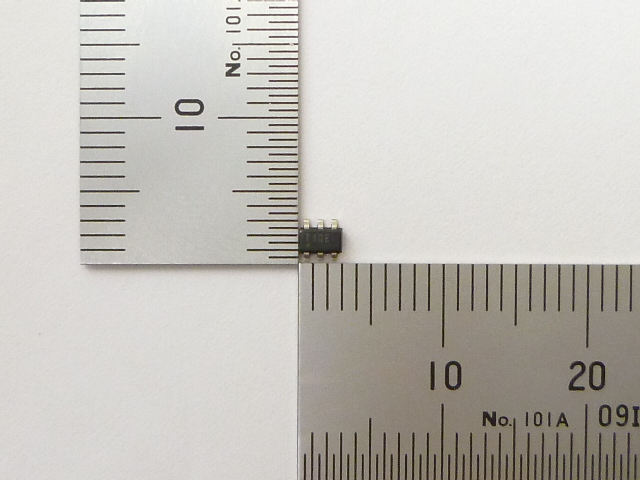
- Code : 1024 Bytes / EEPROM : 0 bytes / RAM : 32 Bytes
- Size: about 3mm x 3mm legs included !! (0。0)
- 2 PWM on PB0 and PB1
- Default speed : internal oscillator 8 MHz
- Homepage http://www.atmel.com/devices/ATTINY10.aspx
Usage
Building code
I do ASM only for these small MCU because wheter it's ultra time sensitive (so count your cycles), or space tight (so manage by myself), or very simple (no need of C). Plus it's good hygiene to do some ASM every few years.To build use avra (source) to install with simple
sudo apt install avra.Build with:
avra -I /usr/share/avra Blink_tiny10.asm
Programming
The chip is so small it cannot use a SPI interface but uses instead the TPI (Tiny Programming Interface). For the AVR mkII programmer, explanation is here.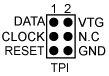
Top view of the connector on the circuit board - Pin 1 = red wire
AVRISP      Target    ATtiny
connector   pins      pin #
1 (MISO)    TPIDATA   1
2 (VTref)   Vcc       5
3 (SCK)     TPICLK    3
4 (MOSI)
5 (RESET)   /RESET    6
6 (GND)     GND       2
(source https://www.nongnu.org/avrdude/user-manual/avrdude_20.html)
Command line:
avrdude -p t10 -cavrispmkII -U flash:w:Blink_tiny10.hex:i -B12 -vREMINDER: once you program it, the program will not start running (!). You have to unplug the /RESET wire (connecting the Tiny10 to the AVR programmer) and you have to unplug the AVR ISP mkII from the USB (!!) Why? Maybe the /RESET line stays forced low. I tried to add a pullup but to no avail. This stays a mystery so far but the article here under in the links mentions the same problem...
Links
- Buy them http://akizukidenshi.com/catalog/g/gI-04575/
- How to program it? http://minisystem.blogspot.jp/2012/01/programming-attiny10-with-avrisp-mkii.html
- Usual ISP programmer http://www.batsocks.co.uk/readme/isp_headers.htm
- Sample programs: PWM, analog in, ... http://junkplusarduino.blogspot.jp/p/attiny10-resources.html
- A programmer using an Arduino (in Japanese) http://d.hatena.ne.jp/pcm1723/20111208/1323351725
Sample codes
All the source codes and samples programs in 1 solution : https://github.com/AlanFromJapan/alanarduinotools/tree/master/Attiny10Random number generator in assembler
I found it here. Adapted it to use with Attiny10, it uses 4 registers r16-19. A bit more work and you could store the last value in SRAM instead, but I didn't need to so I let it as-is...init_vars_rnd: ; init the value so it can be randomized ldi r16, 0xad ldi r17, 0xad ldi r18, 0xad ldi r19, 0xad main: rjmp main ; your program here ; http://www.avrfreaks.net/forum/very-fastsmall-random-number-generator ; 31-bit random number ; primitive polynomial order 31 ; (1)0100000 10101010 10010101 10110101 (20 AA 95 B5) ; shift before XOR rand_31: push r24 lsl r16 ; shift first rol r17 rol r18 rol r19 sbrs r19,7 ; test MSB rjmp rand_31_outro ; clear, no XOR ldi r24,0xB5 ; first poly byte eor r16,r24 ; XOR it in ldi r24,0x95 ; second byte of poly eor r17,r24 ldi r24,0xAA ; same routine eor r18,r24 ldi r24,0x20 eor r19,r24 rand_31_outro: pop r24 ret
Watchdog
Took me some hours to get this one working, as usual nowhere to be found a simple helloworld version of the watchdog for Attiny10... well, there it is fixed now.README: the fuse WDTON must be UNPROGRAMMED (=not checked), otherwise behavior is always to reset, not goto interrupt.
.CSEG
.ORG 0x0000
rjmp main        ;1 0x0000 RESET External Pin, Power-on Reset,VLM Reset, Watchdog Reset
rjmp neant        ;2 0x0001 INT0 External Interrupt Request 0
rjmp neant        ;3 0x0002 PCINT0 Pin Change Interrupt Request 0
rjmp neant        ;4 0x0003 TIM0_CAPT Timer/Counter0 Input Capture
rjmp neant        ;5 0x0004 TIM0_OVF Timer/Counter0 Overflow
rjmp neant        ;6 0x0005 TIM0_COMPA Timer/Counter0 Compare Match A
rjmp neant        ;7 0x0006 TIM0_COMPB Timer/Counter0 Compare Match B
rjmp neant        ;8 0x0007 ANA_COMP Analog Comparator
rjmp WDT_off    ;9 0x0008 WDT Watchdog Time-out
rjmp neant        ;10 0x0009 VLM VCC Voltage Level Monitor
rjmp neant        ;11 0x000A ADC ADC Conversion Complete (1)

; ---------------------------------------------------------
; a dummy handler for unused interrupts
neant:
    reti

main:
    ;----------- Watchdog setup start ----------------------------------------
    ;No interrupts temporarily please
    cli

    ;no reset on watchdog! (clear bit WDRF in RSTFLR)
    in r16, RSTFLR
    andi r16, ~(1 << WDRF)
    out RSTFLR, r16

    ; WDP2 | WDP1 => every second %20 !WDE | WDIE => interrupt on watchdog timeout
    ldi r17, (1 << WDIE | 1 << WDP2 | 1 << WDP1 | 0 << WDE)
    ldi r16, 0xD8    ;0xD( magic value to write in CCP, and then within 4 cycles you can update WDTCSR
    out CCP, r16
    out WDTCSR, r17
    sei
    ;----------- Watchdog setup end ----------------------------------------

loop:
    nop ; main body
    rjmp loop

; Watchdog interrupt body
WDT_off:
    cli
    ;... do something every sec
    sei
    ;reti because it's an interrupt
    reti
electrogeek.tokyo ~ Formerly known as Kalshagar.wikispaces.com and electrogeek.cc (AlanFromJapan [2009 - 2026])